Join our newsletter for resources, tools and insights for the boys in your life. Join our newsletter for resources and insights to support boys Sign up
Cart (0)

Why Mitch Brown coming out matters – for everyone

By Ben Vasiliou


11 years ago I made a life-changing decision. I chose to come out and share that I am a gay man. At 28 years old, married to my wife, with two children.

In the years leading up to that decision, I contemplated another one: taking my own life. I came very close. I thought at the time that my family would be better off having me dead than gay. I was so very unwell, mentally and physically, and was a shadow of the man I wanted to be, my true, authentic self.

Somehow, I dug into the very bottom of my soul and the furthest corners of my heart, and decided that I wanted to make my kids proud of having a gay dad, rather than experiencing the trauma of a dead one.

But then came the hard part. When you’ve told yourself stories for decades that no one would accept your authentic self, you become buried in shame, in stigma, in guilt. The process of unravelling this meant I had to accept that I lied. I lied to my wife, my kids, my sisters (pictured with them below), my friends, my colleagues.

I didn’t want to lie, but I felt I had to, because of what the world told me about being gay. Fa**ot, homo, gay c**t, these were slurs I heard regularly. P**fter, gay and p**sy were everyday words. So I accepted that I was less than. That I was not worthy. 

In the end, the strength and tenacity it took to come out proved to me that I was worthy.

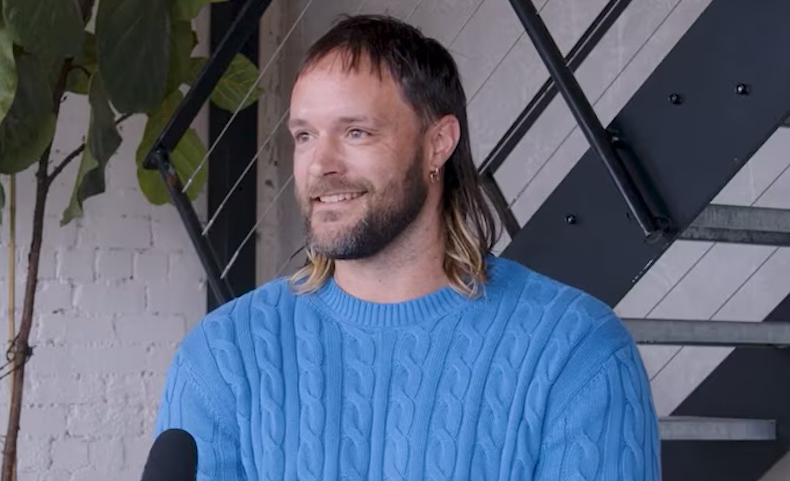
Which is exactly why Mitch Brown’s revelation that he is a bisexual man via The Daily Aus this week – he is the first male AFL player to ever come out – matters so much. As the CEO of an organisation that works with tens of thousands of teenage boys every year, I can’t help but get emotional thinking about the impact Mitch’s bravery will have on the queer young people in our workshops, who now have another positive male role model to look up to.

Us queer folk are scared of what we will lose – loved ones, jobs, respect – and we are scared of what we will welcome in – abuse, shame, judgement. Having role models who have walked that path, stood in their power and claimed their authentic selves are exactly what we need.

It is also not lost on me that Mitch’s story comes a week after a sixth male AFL player was suspended this year for using a homophobic slur.

When AFL players call other players a fa**ot, it matters. Young people are watching and their minds are malleable. Some may take the message that homophobia is fair game. Others, particularly those questioning their sexuality, take the message that there is something fundamentally wrong with them. We only need to point to elevated rates of mental ill-health, self-harm and suicide amongst the LGBTQIA+ population to see where that can lead.

We are at an inflection point; for the AFL, for masculinity, for queer abuse.

And for progress to truly be made, men need to step in and step up.

This is a problem of masculinity. Some may not agree, but I’ve lived it and continue to see it. The problem starts with us, our beliefs, our words and our behaviours.

In women’s sport, countless players are out and proud. It is completely commonplace to see same-sex couples at awards ceremonies. But we’ve never seen a same-sex couple at the Brownlow or the Dally M.

And you only need to take a look at online comment sections in the past few weeks to see why. There have been small pockets of supportive sentiment, but thousands of hate-filled comments – almost all written by boys or men – spewing vile homophobia. Who the hell would want to come out in that environment?

We need to call out homophobic attitudes, because they are doing real harm. But at The Man Cave, we believe in the power of calling boys and men in. Shame is a blunt instrument that, decades of evidence shows, is an ineffective tool for change. 

We need to get real about where homophobic, transphobic, misogynistic and sexist attitudes come from. The fantastic Man Box research, published by Jesuit Social Services, suggests they are rooted in traditional, stereotypical, outdated notions of masculinity. 

That research also shows that boys and men who more strongly adhere to these rigid gender stereotypes have significantly worse health outcomes – they suffer mental health issues at higher rates, they have worse relationships, they are more prone to risky behaviour like binge drinking and gambling, and they are more likely to perpetrate violence or harm themselves. 

We need to invite boys and men into conversations about these rigid gender stereotypes, because they are actively harming everyone – gay men, queer people, women, children, and boys and men themselves. And when we do, like in our workshops, you can feel the shift in the room.

Take the below question, written anonymously by a teenage boy who was in a space where he finally felt safe enough to do so. What followed was a beautiful, mature and respectful discussion in the room about relationships that sit outside the heteronormative standard.

It means having challenging and sometimes politically incorrect conversations, where boys can fumble their way through the scripts of masculinity they have inherited on their way towards building healthier ones. It means providing role models who can show them that there’s another way. It means investing in spaces where boys can practice emotional literacy tools that give them the ability to regulate their emotions, build empathy towards others and set and respect boundaries. 

This isn’t just about the AFL. It is about humanity. It is about ending relentless mental health challenges. It is about empowering people to live their fullest, most authentic lives. And it is about healthy, happy communities where all people, regardless of gender, race or sexuality, can be themselves.

Ben Vasiliou is CEO at The Man Cave. He has spent the past two decades working on the frontlines with at-risk youth, particularly in homelessness, and now drives our Purpose – empowering boys to become great men. He is married to Luke, father of Zane and Matilda, and remains close with his ex-wife, Lee.

Published Fri 29th August, 2025.